“This game is so simple and effective. It can reach someone who knows nothing about sex crimes and someone who has seen it all. How did no one think of this before?”
Behind the game
A collaboration between Studio Jayne, Victim Services Durham Region, Victim Services Toronto, and the Ontario Network of Victim Service Providers, with over $800,000 CAD in funding.












EdTech · Game Design
Own productAsk an adult what their sex education taught them about consent, coercion and sex, and most will say the same thing: not much. Some never had the lesson at all. Likely Story changed just that.
- Role
- Founder and Digital Product Owner, Studio Jayne
- Team
- 20+ contractors across time zones
- Timeline
- 2021 to present
- Platform
- Web · Single-player, Multiplayer, and Educational formats · Toronto, Canada (Remote)
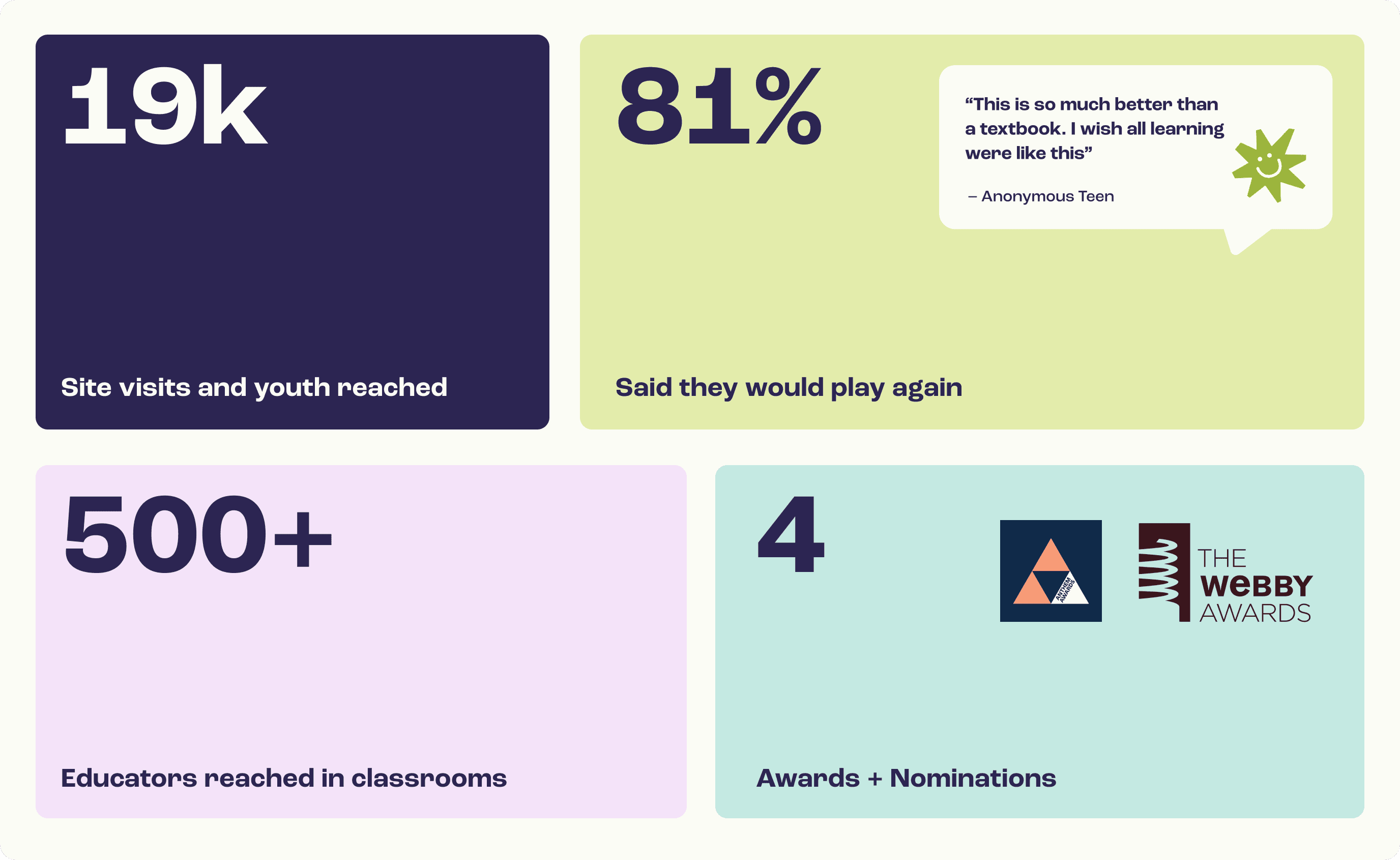
Likely Story reached 30,000+ learners and 500 educators, ranked top five globally at the Webby Awards and earned a Silver Anthem Award, and produced measurable change: a 9% increase in target behaviors and 92% of players responding honestly during play. Trauma-informed and accessibility-first throughout.
Teens don't tune out lessons on consent, healthy relationships, and trafficking because they don't care. They tune out because almost no one will teach the subject honestly, the resources don't exist, the topic stays taboo, and the few programs that try are too sanitized to matter.
I built Likely Story to do the thing the field avoids: teach it factually, from real scenarios, in a format teens actually want to play. I founded Studio Jayne and owned the product end to end, discovery, design, launch, evaluation, and scaling.
I raised and managed over $800K in grant funding and NGO partnerships, hired and led 20+ contractors across time zones, and shipped single-player, multiplayer, and educator formats with analytics, KPI tracking, and WCAG accessibility built in from day one. The result: 30,000+ learners, 500 educators, a top-five global Webby and a Silver Anthem Award, and in the data that matters most, a measured 9% increase in target behaviors and 92% of players answering honestly during play.
Trauma-informed and accessibility-first throughout.
Ask an adult what their sex education taught them about consent, coercion, or how to tell when someone online is grooming them, and most will say the same thing: not much. Some never had the lesson at all.
Many will tell you it was ineffective, and the part they wanted most, the emotional and psychological side of relationships, is the part almost no one teaches. In Canada there is no national strategy for any of it, so whether a teen learns to recognize danger comes down to which classroom they happen to sit in.
Meanwhile the stakes climbed: since the pandemic, online sexual abuse is up 88% and reported STIs among youth have more than doubled. Most programs that teach teens about consent, sexual health, and trafficking prevention fail- not because teens tune them out but because we don't invest enough to teach them.
Funding is scarce and the shame around these topics runs deep, so they stay too contentious to teach openly. The cost lands on teens, who are left to figure it out alone.
The hard part was never the teenagers. It's us.
Consent, sexual health, and trafficking prevention are taboo enough that most adults avoid teaching them at all, and where the will exists, the funding and resources don't. What teens actually get is sanitized, fear-based, or abstract, nothing like the situations they're navigating in real life.
So they disengage. Their tuning out isn't the disease; it's the symptom of a system unwilling to talk to them honestly.
That was the design problem: do the thing the field flinches from. Teach this factually and from real scenarios, to a population that includes survivors, without lecturing and without re-traumatizing, and make it something teens choose to play, not something assigned to them.
Research & discovery
“My students wanted to play it over and over again.”
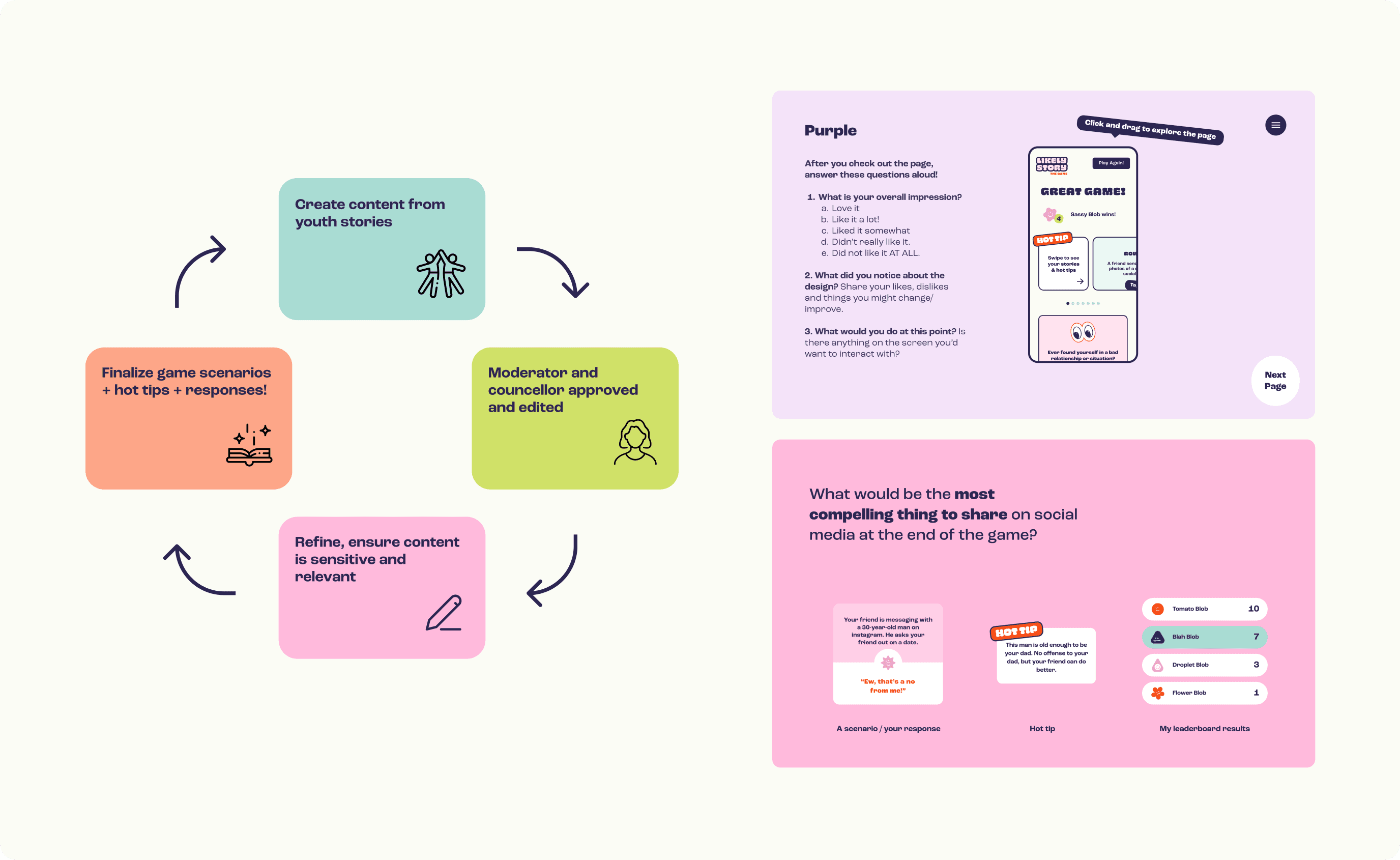
I applied mixed-methods research throughout development, working with a sensitive population using a trauma-informed approach from the start. Interviews, playtests, expert review, and pre- and post-game evaluation ran in continuous cycles from early prototype through post-launch.
Agency Beats Instruction
Teens disengaged from direct instruction but leaned in when they had real choices and could explore consequences safely. The format had to put the player in the driver's seat.
Safety Is a Precondition for Honesty
Feeling unjudged came before learning. No quizzes, no scoring, no surveillance. The design had to earn trust before it could teach anything.
Educators Need Turnkey Materials
Without curriculum-aligned, easy-to-run resources, adoption stalled at the teacher. The educator surface needed the same design care as the game itself.
The solution
Likely Story is an interactive story where teens step into a scenario, make choices that shape who they become, and live with the consequences. Sessions run about 20 minutes and are replayable. It ships in single-player, multiplayer, and educational formats, with educator materials that make it deployable in a classroom in under ten minutes.
Flow 01
Single-Player Story Mode
The core experience: an interactive story built for a 20-minute session. Designed for individual learners and home use.
Flow 02
Multiplayer Classroom Mode
Up to 30 students play the same scene in parallel. The class compares choices through an anonymized live view. The teacher facilitates from a prompt deck the game generates automatically.
Flow 03
Educator View
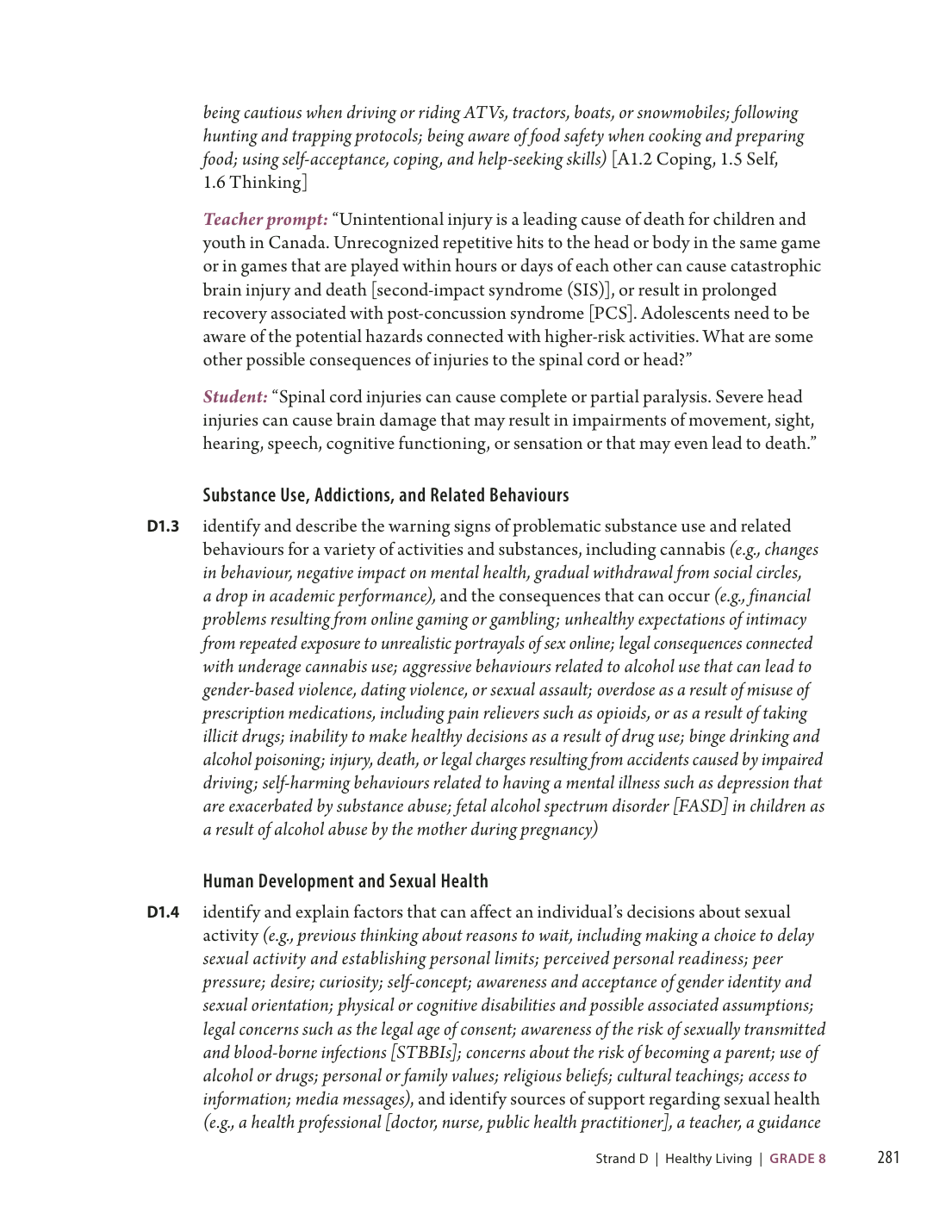
There is no national standard for sex ed in Canada or the US, every district hands teachers a different document and expects them to deliver it. The game gives educators lesson plans, scene-level content warnings, opt-out controls by topic, and debrief prompts written by sex educators, all mapped to the outcomes their curriculum is graded on. This surface is what made it adoptable across districts with different politics and different needs.
Before — What teachers are handed
After — What teachers can actually run
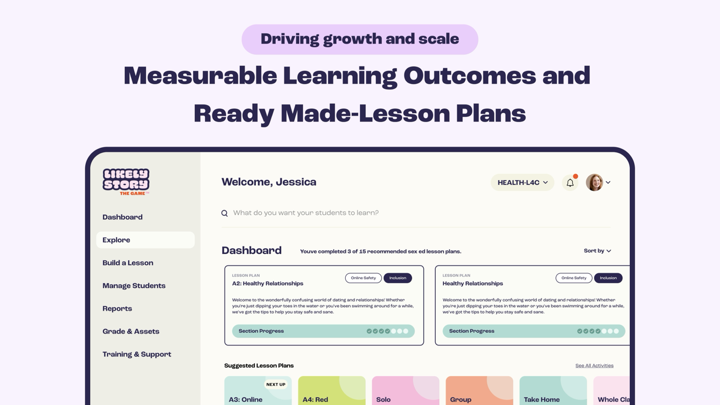
Real screens and brand assets from likelystory.game. No mockups. The brand was built for teens: vibrant, character-led, and nothing like a textbook. Players create a blob avatar before they see a single piece of content, identity before instruction. Post-game, a resource library hands learners off to videos, hotlines, and support contacts. Every scenario was built from real youth stories, reviewed by counselors, refined for sensitivity, and playtested with classrooms before shipping.
“This is so much better than a textbook. I wish all learning were like this.”
Outcome & impact
The measurable results and what changed for people.
Real evaluation data, not vanity metrics. Measured across two years of deployment in Canada and internationally.
Next project
Building Social Impact Into a Global Design Agency